
The Problem With Asking "What Worked?"
One of the most common questions we hear is:
"What worked?"
A new customer reaches out, and naturally, businesses want to know what brought them in.
Was it the referral?
The email campaign?
The networking event?
The social media post?
The challenge is that marketing rarely works in a straight line.
Most buying decisions aren't the result of a single interaction. They're usually the result of multiple interactions happening over time.
A recommendation plants a seed. A website visit creates familiarity. A social post serves as a reminder. A newsletter keeps your business top of mind.
None of those moments may feel particularly important on their own.
Together, they can be the reason someone finally decides to reach out.

Think About Your Own Buying Habits
When was the last time you hired a service provider?
Most people don't:
☐ Discover a company
☐ Reach out immediately
☐ Sign a contract
Instead, they tend to:
☐ Explore options
☐ Get distracted
☐ Return later
☐ Compare alternatives
☐ Reach out when the timing feels right
That's completely normal.
In fact, it's how most buying decisions happen.
Yet many businesses expect potential customers to move much faster than they do themselves.


Visibility Has A Different Job
This is where marketing can become frustrating.
Not every marketing effort is designed to generate an immediate response.
Sometimes the goal is simply to stay visible.
A blog article may not create a customer this week. A social post may not generate a phone call tomorrow. A newsletter might not produce a direct inquiry at all.
And that's okay.
Their job is often much simpler: helping people remember you when the timing is right.
Because people can't hire a company they've forgotten exists.
The businesses that stay visible are often the businesses that come to mind first when someone is finally ready to take action.
The Last Touch Isn't Always The Most Important One
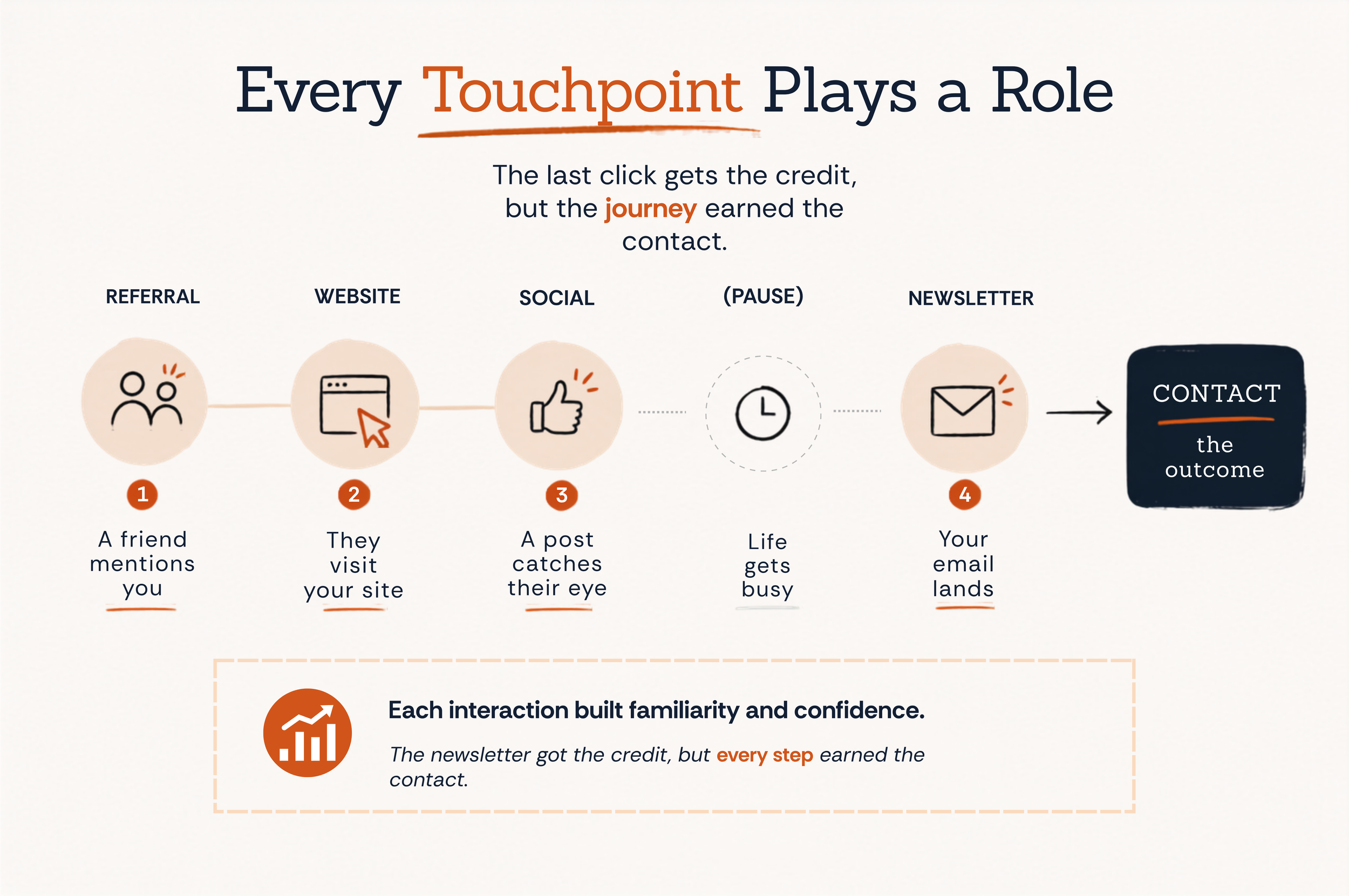
Most customer journeys don't happen in a straight line. Someone hears about you from a friend, checks out your website a few weeks later, sees a social post, and then, after a quiet stretch, a newsletter lands in their inbox and finally pulls them back. By the time they reach out, it's tempting to credit whatever they clicked last. But that final touchpoint rarely tells the whole story. Every step along the way did its job: sparking recognition, building familiarity, and earning enough trust to make the next step feel natural.
A Better Question
Instead of asking, "How many customers did this create?" try asking, "What role did this play in the decision?" Marketing isn't usually a single event that changes someone's mind. More often, it's a collection of small interactions that build familiarity and trust over time. The businesses that see the best long-term results usually aren't chasing one magic marketing win. They're focused on staying visible, staying helpful, and showing up consistently. Because while an individual email, social post, or blog article may eventually be forgotten, the confidence built through consistent marketing tends to stick around much longer.